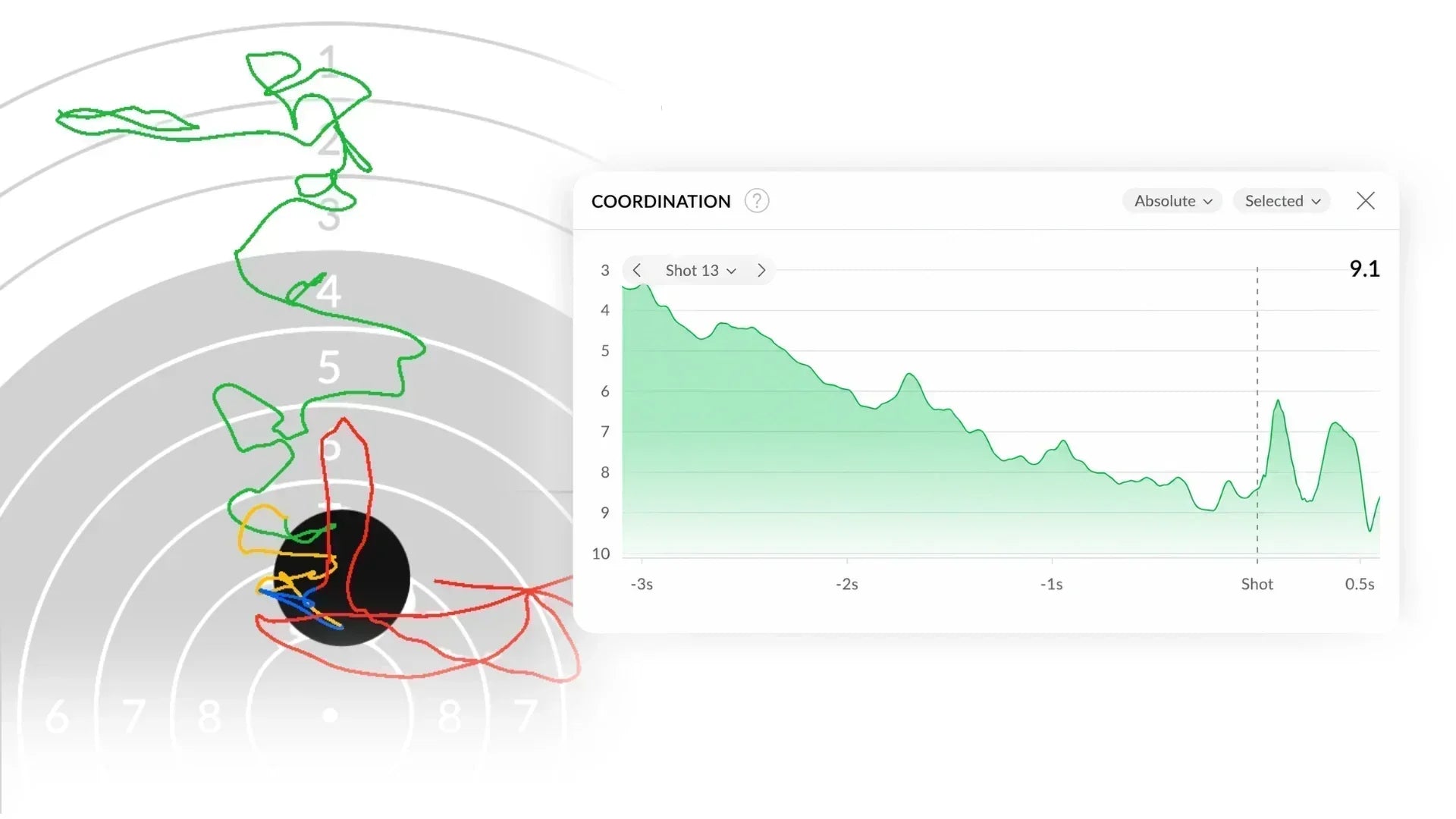

The SCATT Training System as the Shooter's Primary Tool for Assessing Hold Stability
Part 1. Parameters That Characterize the Quality of Firearm Hold Stability
Here we will not consider every question and problem that shooters and coaches face on the path to podiums and medals. We will not address equipment, physical preparation, psychological preparation, or other aspects of a shooter's training. We will focus on only one aspect of technical preparation.
The main condition for a high level of technical preparation is good firearm hold stability. Three principal factors, or indicators, characterize the quality of stability:
- The amplitude of movement, meaning the movement of the aimpoint across the target.
- The location of the movement, meaning how closely the mean point of aim coincides with the center of the target.
- The speed of movement.
The SCATT software can also monitor other stability parameters, including the ellipticity of movement, the predominance of horizontal or vertical deviations, graphs showing changes in speed and aimpoint deviation, and a number of other parameters. Here, however, we will consider only the three principal general indicators listed above.
There is another very important factor that does not directly reflect the quality of stability but has a substantial influence on shooting performance. It is the ability to maintain these three indicators at the moment of the shot. We will not consider this factor here either, because it requires special attention and will be addressed in more detail separately.
When considering these three stability indicators, it should be noted that all shooters and coaches try to evaluate them during training. However, evaluations based on visual perception and the shooter's sensations are highly subjective. For this reason, a hit in the center of the target is often regarded as a technically correct shot, although it may actually be the result of two overlapping errors. The screenshot clearly shows an aiming error. However, the shot reached the 10-ring because the shooter made a technical error at the moment of the shot by jerking the aimpoint toward 5 o'clock.

The opposite can also occur. The screenshot shows a shooter with very good amplitude and speed values who made an error only in the location of the aiming area. Although the shot was technically correct in the other respects, it landed outside the 10-ring.

In this case, as in many others, SCATT becomes an indispensable and highly effective tool for obtaining the most objective information possible about stability indicators.
The amplitude of movement is shown as the percentage of time the aimpoint remains within the actual 10-ring during the final second before the shot, and within a zone the size of the 10-ring centered on the mean point of aim, or MPA. In the latest version of the SCATT Expert application, the shooter can independently set the size of the control zone for different parameters in increments of 0.1 of a scoring ring. This is very important because shooters have different skill levels.
By comparing the percentages of time spent within the actual selected zone and within the zone centered on the MPA, it is possible to assess the second stability indicator: the accuracy of the location of the aiming area. The smaller the difference between these values, the better the centering of the shots and the fewer unjustified point losses caused by the mean point of impact for the complete session, or one part of it, failing to coincide with the center of the target. In the screenshot, the magenta arrows show that the aimpoint spent 0% of the time within the actual 10-ring, while it spent 48% of the final second within a zone the size of the 10-ring centered on the mean aimpoint.

The speed of movement is shown numerically in millimeters per second, referring to aimpoint movement projected onto the target. Two values can be displayed: the average speed during the final second of aiming before the shot and the average speed during the final 0.25 seconds. In the screenshot, these values, together with the graph showing how speed changed during the final second, are marked by yellow arrows.
Why is the second speed value needed? The software developers understand that the final moment before the shot is especially important. Because the physiologically determined visual-motor reaction time of a trained person is approximately 0.25 seconds, this speed value shows whether the trigger finger continued to work normally and independently, or whether additional muscles became involved at the final moment before the shot. Such additional muscular action is inevitably reflected in the second speed value.
This can be seen clearly in the screenshot. The average speed during the complete final second is 18.9 mm/s, while the speed during the final 0.25 seconds rises sharply to 27 mm/s because of additional muscular action caused by tense anticipation of the shot. It can be assumed with a high degree of confidence that this surge resulted from additional action by the right shoulder of the air-rifle shooter. Aimpoint speed can be examined in greater detail on the graph in the analytical section of the software. Without SCATT, it is impossible to evaluate the stability indicators listed above objectively or to see the technical errors shown in the screenshots.
Part 2. Priorities Among the Parameters That Define the Quality of Firearm Hold Stability
It is self-evident that the higher the percentage of time spent within the 10-ring, or another selected zone, the better. In other words, the smaller the amplitude of movement and the lower the aimpoint speed, the better. However, when considering these three principal indicators of firearm hold stability, an important question arises: which indicator has the greater influence on the final result?
I have often been both a witness to and a participant in debates on this subject. Over more than 30 years of observing my fellow coaches and other athletes use SCATT training systems, I have seen that in most cases they display only the shot result and speed on the main screen. In earlier versions, speed was shown as the length of the aiming path. Some users limited their review to the result and the aimpoint path during shot replay.
From my conversations with them, I concluded that most regarded speed as the dominant factor in determining the quality of stability. They generally paid no attention to the percentage of time spent within a selected zone or to the speed during the final 0.25 seconds.
When I took part in these debates, I usually argued my position as follows. First, let us set location aside. It is certainly an important indicator, but we will assume that the shooter has a consistent aiming-area location and makes sight adjustments when necessary. This leaves two disputed parameters: the amplitude of movement, meaning the size of the aiming area, and aimpoint speed.
To those who consider speed the most important factor, I ask a simple question: in terms of the final result, which is better, slow movement within the 9-ring or faster movement within the 10-ring?
For example, Shooter 1 has an amplitude value of 100% within the 9-ring and 60% within the 10-ring, with a speed of 50 mm/s. Shooter 2 has amplitude values of 100% within both the 9-ring and the 10-ring, but a higher speed of 70 mm/s. Which shooter has a chance of producing the higher result? Clearly, Shooter 2. During the final second before the shot, the aimpoint never left the 10-ring, while Shooter 1's aimpoint was within that ring for only 60% of the same period.
Of course, my opponents could argue that to hit the 10-ring it is not necessary to remain within it for the entire second; it is enough to bring the aimpoint into that zone at the final moment before the shot. They could also point out that the ballistic coefficient has a greater influence on shot displacement at a higher speed. These objections can be answered with the following arguments.
Unlike Shooter 1, Shooter 2 does not need to bring the aimpoint into the 10-ring at the final moment because it has already remained there throughout the final second. If a more precise hit is required, as in air rifle or in a final where tenths of a point are counted, Shooter 2 still has a clear advantage. As for the ballistic coefficient, the difference in displacement at these speeds is negligibly small. In addition, it can affect a shot both when the aimpoint is moving away from the center of the target and when it is moving toward it.
Two conclusions can be drawn from the above. The first concerns the direct priority of movement amplitude in its influence on shooting performance. The second is broader: the SCATT developers included so many options and capabilities in the software for good reason. The more fully users employ these capabilities, the more effective the training process will be.
Author: Stanislav Lapidus, Coach