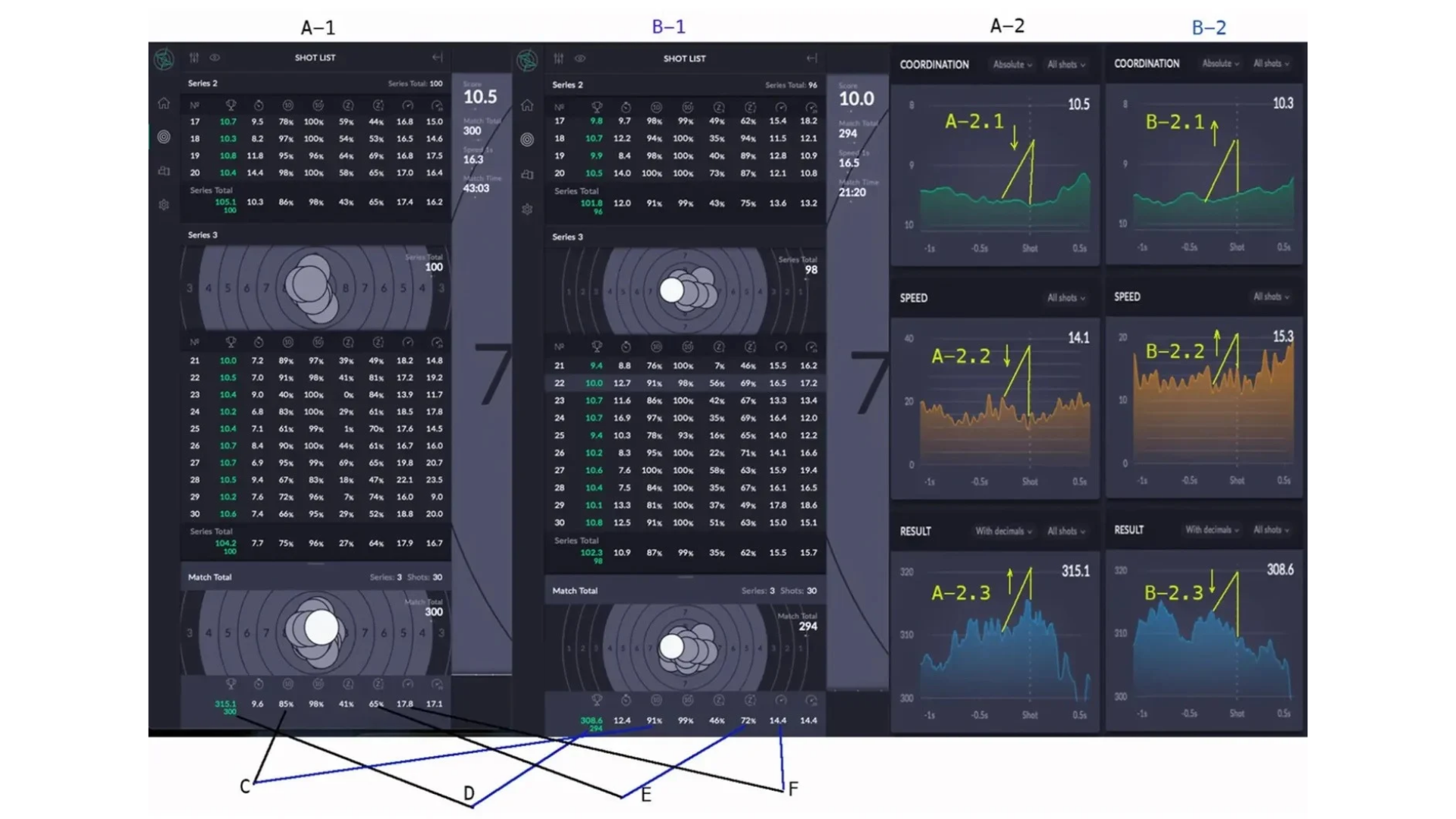

When a shooter sees fast gun movement in SCATT, their first thought is often: “To improve my results, I need to reduce the movement.” That thought can change the entire direction of their training.
The athlete tries to control the gun more actively, find a more stable shooting position, and make the movement slower and calmer. All of this is aimed at producing a better-looking trace on the screen. But the key question is: how does it affect the quality of the shot itself?
Gun movement differs from one athlete to another. Some shooters have faster movement with little effect on shot quality. Others have very slow movement, yet their results may actually be worse. The difficulty is that movement speed is not always the underlying problem. Very often, it is a consequence of something else. Where do those small, rapid movements come from? One common cause is excessive muscle tension.
When an athlete tries too hard to control the gun, they may use more muscular effort than is needed to support it. Some muscle groups tense to maintain the position, while others work against that tension. This creates a cycle: tension produces more movement, and the athlete responds by trying even harder to control it. Rather than settling down, the hold becomes less stable. Greater muscle tension can also mean more tremor. In SCATT, this may appear as small-amplitude, high-speed movement in the aiming trace.
The goal of training, then, is not simply to produce a neater line on the target. It is to find a balance: the minimum muscular effort needed to hold the gun steadily and execute the shot well. Improving hold stability is certainly important. But even a substantial reduction in movement speed does not, by itself, mean that the athlete has learned to shoot well. Shot quality depends not only on how fast the gun is moving, but also on what the athlete does while that movement is taking place.
This is where good trigger control can matter more than a perfect hold. The shooter does not need to wait until the gun becomes completely still. That moment may never come. There will always be some movement. The real question is whether the athlete can make effective use of the available window for executing the shot.
Heart rate is linked to breathing: it generally increases slightly during inhalation and slows during exhalation. Muscle tone is also connected to breathing. Even when the athlete feels relaxed, inhaling can bring a slight increase in muscular tension, while exhaling encourages relaxation.
To execute a quality shot, the shooter uses breathing to relax more deeply and lower their heart rate. The approach to the target takes place during exhalation, followed by aiming during a pause in breathing.
Here is the important point: holding the breath may feel as though it should make the body become still and slow down. In practice, however, the heartbeat can gradually become faster and more forceful, while muscle tone may also rise without the shooter noticing. As aiming continues, hold stability can deteriorate. The aim is therefore to use a 3-5 second window during the breathing pause, while pulse-related movement and muscle tension are still low.
If an athlete only begins applying trigger pressure once the gun has reached the centre, they make themselves dependent on a moment of ideal stability. First, the gun has to settle. Then the athlete has to recognise that moment. Only then do they begin and complete the movement of the trigger finger. This sequence can easily lead to a prolonged shot.
An athlete who has learned to begin trigger work earlier, and to continue it through small, natural movements, can execute a quality shot even when movement speed is relatively high. By contrast, a very steady trace may offer little benefit to a shooter who keeps waiting for the perfect moment and begins applying trigger pressure too late.
That is why it is more useful to teach a shooter to work the trigger effectively with their current level of stability than to spend months trying to perfect the trace first. During training, move beyond judging a series solely by asking, “Has the movement decreased?” Look at the wider picture.
Pay attention to what happens before the shot. When does trigger work begin? How does the trace change when the trigger finger starts working? How much time passes between entering the central aiming area and releasing the shot? Does the athlete tense up more as the gun reaches the centre? Does the trace become steadier immediately after the shot?
That last question is particularly interesting. Sometimes a shooter discovers that the gun moves more calmly after the shot. This may indicate that unnecessary muscle tension was present during aiming and disappeared once the shot was released, when the athlete stopped trying so actively to control the movement.
When training with SCATT, look beyond movement speed and examine the full shot sequence. Compare aiming time, the start of trigger work, changes in the trace before the shot, and the gun’s behaviour afterwards.
If movement becomes slightly faster but the shot is executed at the right time, that does not necessarily represent a decline. Equally, a much neater trace may provide no real advantage if the athlete still waits for the perfect moment, prolongs the aiming process, and starts working the trigger too late.
Improving hold stability is not about achieving the slowest, neatest trace at any cost. What matters more is learning to execute a quality shot with the movement that is currently present. SCATT should help the athlete answer one question: “How well am I using the stability I already have?”