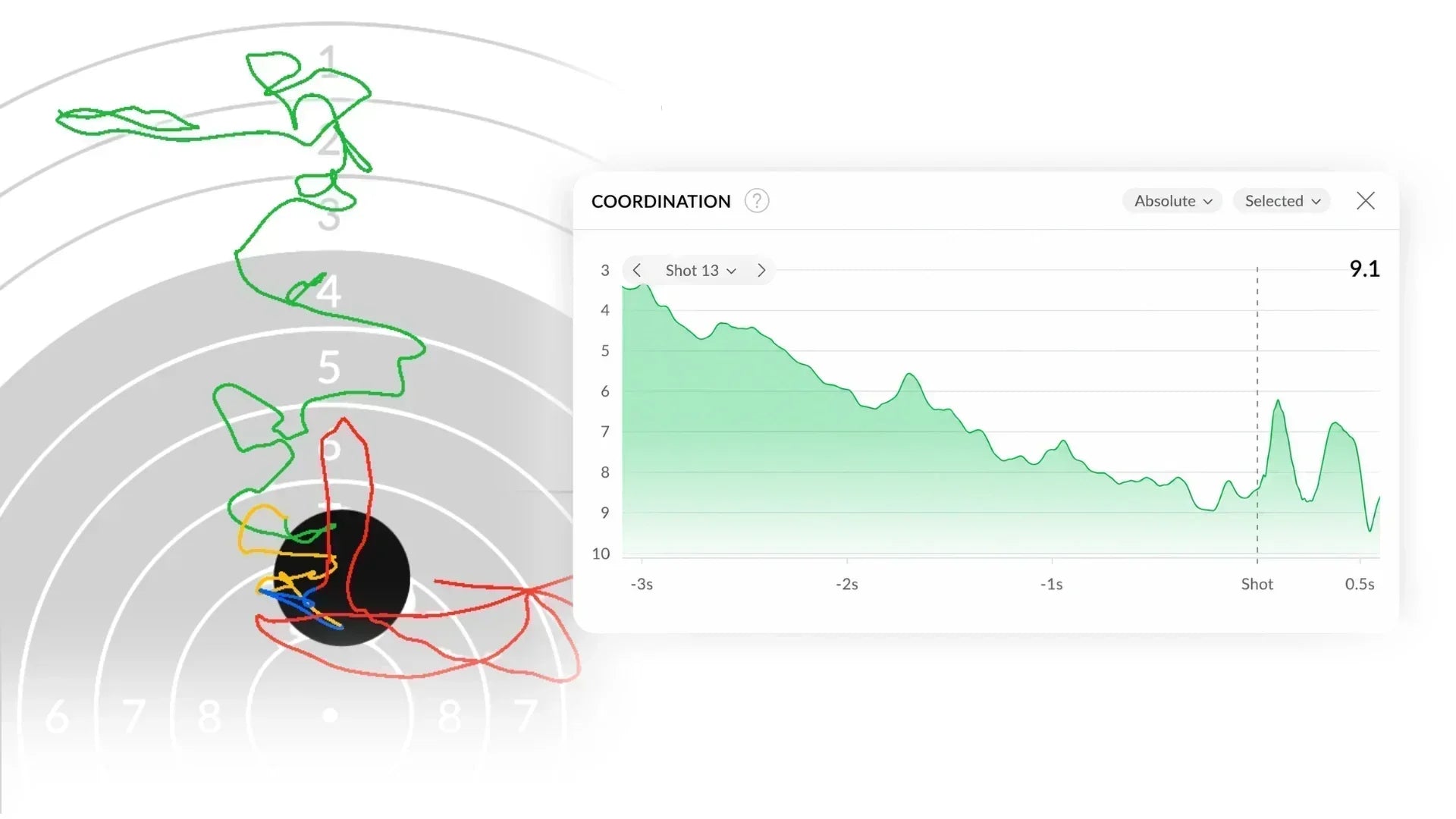

When one shooter holds the gun more steadily than another and also achieves a better result, that seems logical. It is equally logical when the same shooter scores better on a day when their hold is objectively more stable. But this is not always what happens.
Every shooter and coach has encountered the paradox of two athletes whose hold stability differs visibly, even according to objective SCATT measurements, yet the less stable shooter scores higher. It can also happen to the same shooter: the hold improves while the result gets worse, or vice versa. This occurs more often, and is more noticeable, in events where the gun is less stable, particularly pistol and standing rifle.
Today we will examine this paradox.
How should hold stability be assessed?
First, we need to define how to assess hold stability. I discussed this in detail in an earlier article. To recap, there are three main measures:
- The speed at which the aimpoint moves across the target.
- The amplitude of the front sight's movement, or the aimpoint's deviation.
- The consistency of the aiming area on the target.
I concluded that the second measure, movement amplitude, is the dominant one. Here I mean the final phase of aiming, usually one to three seconds before the shot, rather than the entire aiming period. Its length varies greatly between shooters. For one athlete it may last three seconds or more, while another's aimpoint may settle less than a second before the shot.
There is another very important factor that does not directly describe hold stability but has a substantial effect on the shooting result. It is the ability to maintain these three measures at the moment of the shot. We will not examine this factor here, as it deserves special attention, and will return to it in more detail.
That is what we will do now.
In fact, any hold, however stable, can be disrupted in the final instant before the shot or during the brief moment of its execution. Please pay particular attention to this point. In my view, it concerns the most important aspect of true skill in target shooting, at least in the so-called slow rifle and pistol events. Its main principles also apply to rapid-fire pistol.
When better stability produces a worse result
The composite below brings together the stability measures and results of the same air-rifle shooter. The SCATT files contain the same number of shots, recorded under identical conditions 11 days apart.
Example of the Paradox in the Relationship Between Shooting Results and Hold Stability

The columns of SCATT screenshots are labelled A-1 and A-2 for the session with the better result but poorer stability, and B-1 and B-2 for the session with better stability but a poorer result. The latter session actually took place first.
The letters C, D, E and F, with arrows, identify the relevant figures. C shows movement amplitude as the percentage of the final second before the shot during which the aimpoint remained within the actual 10.0 zone. D shows the scores in whole points and tenths. E shows another important measure: stability relative to the size of the 10.5 zone. F shows the average speed of the aimpoint on the target.
The A-2 and B-2 columns contain graphs of the two sessions. A-2.1 and B-2.1 show the coordination curve over the last second before the shot and half a second afterward. The lower the curve, the closer the aimpoint is to the center of the target at that moment. A-2.2 and B-2.2 show aimpoint speed. A-2.3 and B-2.3 show the score that would correspond to the aimpoint's position at each moment.
All the graphs show averages for the 30 shots. The figures and curves show that, in one session, the shooter had better stability by every measure yet achieved a lower score. That is the paradox we are examining.
After the session with better stability but the poorer result, the athlete's errors were reviewed with him. In the next session, he concentrated less on stability and more on the subject of the rest of this article.
Why visual-motor reaction time matters
To understand the problem, let us go back to the beginning. Think of your first steps in shooting sport. Those experiences differ, so imagine a beginner who has received the necessary safety instruction and is handed an air rifle for the first time.
Asked to aim at a target from the conventional standing position and fire a shot, the beginner sees the front sight moving across the target, or the target seeming to jump inside the sight. Two serious mistakes are likely to follow.
The beginner tries to stop the movement by muscular effort and, when the sight briefly reaches the desired position, pulls the trigger abruptly. Other muscles act along with the index finger. The shot lands far from the point where the beginner remembers the sight being.
If this pattern continues, the shooter may become a “hunter,” trying to freeze the sight and catch the moment when it looks right. These two errors can become ingrained below the level of conscious thought. Later they can be extremely difficult, and sometimes impossible, to correct.
This is why sound initial training methods matter so much. I will not discuss a specific method of beginner training or of correcting these errors here. I am, however, convinced that SCATT is essential at every stage. It helps the coach see technical mistakes and draw the shooter's attention to them, so that training does not take an unproductive direction.
Now let us examine the nature of these mistakes and what happens to a beginner, or sometimes even an experienced shooter after many hours, days or years of practice. It comes down to physiology and learned habits.
Approximately 0.3 seconds pass between the moment the shooter's eye sees the correct sight picture and the moment the finger presses the trigger. For some people the interval is shorter, around 0.20 to 0.25 seconds.
To see that the muscles cannot respond instantly to what the eye sees, try this experiment. Ask a friend to watch you hold a pencil vertically by its upper end with two fingers of one hand. Place the thumb and forefinger of your other hand around the middle of the pencil. Release it with the first hand and catch it with the second. Repeat the exercise a few times. You will find that catching it is easy.
Now hold the pencil by its upper end and ask your friend to catch it in the same way, leaving enough space below their fingers for it to fall. They will catch it only by chance. They cannot do so through a deliberate response to seeing it fall.
In the first case, the brain coordinates the two hands at once: release and catch. In the second, the fingers need time to react to what the eyes have seen. This is visual-motor reaction time.
What does a falling pencil have to do with shooting, and with the paradox under discussion? A great deal.
When a shooter sees the front sight in the right place and then presses the trigger, the shot occurs after the same kind of delay as the response to the falling pencil. That is why the hit is often somewhere other than the shooter expects.
One reason is that the aimpoint continues along its natural path within the usual amplitude of movement. Sometimes, and quite often for some shooters, the trigger finger's action is accompanied by the action of other muscles that affect how the gun is held.
I have written before that this happens especially often when attention is concentrated on the moment of the shot. Neither the shooter nor a coach standing nearby may notice the sight move away from the intended point immediately before the shot.
The decisive moment before the shot
Now to the paradox itself: a shooting result that does not correspond to the quality of the hold. The amplitude of movement may be smaller, as shown by the greater percentage of the final second spent inside the 10.0 or even 10.5 zone. The average aimpoint may deviate less from the center, and its average movement speed may also be lower. Yet the result is worse.
We saw this in the composite above. The figure below brings together the coordination curves from the two sessions.

The red curve represents the session with the poorer result; the blue curve represents the session with the better result. In the final moment, during the period of visual-motor reaction, the red curve moves upward, taking the aimpoint farther from the center of the target.
This shows that the better stability measures were not maintained immediately before or at the moment the shot was released. When muscular activity disrupts the hold in a large enough number of shots, the paradox appears.
Conversely, a less stable hold whose characteristics are maintained at the moment of the shot can produce a higher score. This makes the ability to avoid disturbing the hold while executing the shot, in my view, a principal measure of a shooter's skill.
Some shooters and coaches may disagree. They may argue that good hold stability is the primary measure of skill and the main technical condition for a high score, setting psychology, tactics and other factors aside.
My point is that good stability can be developed through sound training methods with almost complete certainty, whereas technical mistakes at the moment of shot release, once deeply ingrained, are very difficult to remove. Some shooters even end their careers after deciding that their efforts to correct them have failed.
Fortunately, the errors developed early in the training of the shooter in this example can be corrected.
Conclusion
The most effective way both to identify the cause of the paradox discussed here and to prevent such serious errors is to include SCATT in the shooter's training methods at every stage, including the initial one.